Preparing The Alfatross for her appearance at the Arizona Concours and the Santa Fe
Concorso, we put only a few gallons of gas in the tank and didn’t
worry much about how accurate the gauge was.
Now it was time to correct that. After filling the gas tank up completely for the first time I was
disappointed to find that the gauge still read “0”. Because the Veglia BENZINA
gauge was restored recently by Mo-Ma Engineering I figured the problem was
more likely a faulty sender. With the
sensor out of the tank, moving the cork float arm up and down produced erratic
readings on my ohmmeter, so something was wrong inside.
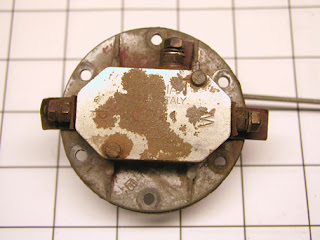 |
Top of the benzine gauge sender. Gauge
connects to W terminal, T connects to
warning light, third terminal is unused. |
 |
| Bottom of sender with float rod. |
A quick surf
on the internet revealed that modern reproductions of the Veglia sender with more reliable solid-state electronics inside are available for
purchase. But I had some reservations. That might be the easy way to solve the problem, but on the other hand maybe reproductions
would not be calibrated to work with the original gauge--and those reproductions are expensive!
 |
| Reproduction senders look very similar to the original. |
Never having
dissected a mechanical fuel level sender before, I saved the reproduction
option as a last resort if the original was not salvageable. Opening the casing revealed that the
components inside seemed to be in good condition in spite of their age. At the heart of the sender is a very Old
School, very delicate, coiled wire rheostat attached at either end to terminal
screws and curved copper blade contacts positioned above and parallel to the
sides of the rheostat coil. A fine wire
from one end of the coil ran to a third terminal screw on one side of the case. Removing the terminal screws and rheostat coil revealed the grounding “brushes” mechanically attached at the bottom of the
case to the float arm.
 |
The rheostat coil, blade contacts, and terminals. Tips of
the brushes are out of sight. |
 |
The grounding brushes below the rheostat coil in the
"full tank" position |
The sender performs two functions: monitoring the fuel level in the tank and illuminating a warning light inside the gauge when the level gets too low. As the float arm sinks, the brushes move
along the sides of the rheostat, reducing resistance. The gauge translates resistance into movement
of the needle from full to empty. When
one of the brushes makes contact with the copper blade near the end of its
travel, it completes the light circuit at the third terminal screw. Turns out, this was the problem area.
 |
The rheostat, a little discolored but otherwise completely functional. The
insulated fine wire making the connection to the warning light was
shorting out on the casing, causing erratic readings. |
After
cleaning the contacts I bench-tested the sender with the gauge to make sure
the old team agreed to work together again, and they did.
 |
Testing the cleaned up and reassembled sender for compatibility with the gauge. The problem was easy to fix--
but hard to pinpoint. |
So the BENZINA gauge is reliable now, but what about the ACUA and OLIO temperature and OLIO pressure gauges? They're coming up next, and I have a feeling we're going to have problems with them, too. I have some spare senders for both oil and water, but what if there are problems with the gauges themselves? We'll soon find out.


